
Chapter 14: The Offers
Your segment is hibernating. How to build offers that wake them up and keep them coming back.
We’ve come to the final chapter of the book.
And yet this is where most marketing books tell you to start.
Wanna get a constant flow of customers? Wanna know the secret to online success? Wanna make your competitors say “Mon Dieu!” in awe of your success? All you need is one offer people can’t refuse, one hyper-optimized funnel, and one ad using this groundbreaking approach!
That’s all you need! It’s that easy!
More exclamation points!!!
Fuck that.
If it were that easy, everyone would do it. But a sales funnel is not a business. Neither is an offer. Or an ad campaign. Selling stuff to people is hard. It takes time. It’s meant to be hard.
My friend Billy Broas was advising an online course creator making $40,000 a month solely from Facebook Ads. Sounds like a good business, doesn’t it? $40,000 a month! Nearly half a million a year. Who wouldn’t want that?
Not so fast.
The ads inevitably stopped working after a couple of months, his revenue went to zero overnight, and he had no other option but to shut down the business. Why? Because it had no foundations—no unique positioning, no distinctive brand, and no continuous reach—just an offer sitting on top of a house of cards (refer to my brilliant sketch in Figure 14.1) that would collapse as soon as one of the flavor-of-the-month tactics stopped working.
Figure 14.1. Not the sturdiest foundation, to put it mildly.
“This is the big mistake I’ve seen well-intentioned business owners make,” says Billy. “They jump from tactic to tactic, thinking the next one holds the key. Instead, they should build their business on a solid foundation of principles.”
Lucky for you, since you’ve followed this book’s methodology from the start, you do have those principles in place. The offer is the cherry on top.
The Problem: Your Segment Is Hibernating
Let’s rewind for a moment to talk about the core principle behind a good offer that stands the test of time. You see, our minds tend to operate on autopilot 95 percent of the time. A compelling offer acts as a jolt to snap your segment out of it. Daniel Kahneman, the Nobel Prize in Economics winner, proposed that our brains operate using two distinct systems, as shown in Table 14.1.
Table 14.1. System 1 Versus System 2
| System 1 | System 2 | |
|---|---|---|
| Proportion of brain activity | More than 95% | Less than 5% |
| Speed | Fast | Slow |
| Effort | Low | High |
| Default usage | Routine decisions, habits, simple tasks | Complex problem-solving, focused attention |
| Decision-making | Intuitive, impulsive | Logical, analytical |
Therefore, introducing something new to your segment’s brains is like attempting to wake up an Arctic ground squirrel buried under the snow. And let me tell you, it’s not easy: its body temperature drops as low as −2.9°C without freezing—the lowest known body temperature of any mammal in hibernation. Its heart rate slows from 200 beats per minute to one beat every few seconds. In short, the rodent isn’t just asleep; it’s almost dead.
Most people’s brains operate in a state of conservation, sticking to known patterns and resisting change. We better come up with something good to wake them up from this slumber.
The Solution: You’ve Gotta Wake Them Up
That something good is your offer. An offer is designed to compel action from the folks in your segment—like trying software, buying a product, or downloading a movie. It’s a clear, concise proposition stating how you will help them overcome their struggles and get the job done. But it isn’t some magic trick you pull out of a hat at the last minute. It’s the culmination of all the hard work you’ve put in so far.
First, a good offer is not about tricking people into buying. It’s about presenting a solution so irresistible, so perfectly aligned with their struggles, that they are more likely to say yes. For the people in your segment, it almost feels like you’re reading their minds.
For example, Jon Goodman from the PTDC knew that personal trainers needed something other than Google Sheets to share their individual fitness programs with their clients. He spent tens of thousands to develop a coaching software solution and offers it for free. No tricks, no trials, no hidden fees. The PTDC gives the software as a free gift and hopes users will turn to the PTDC if they need support in other business areas.
Second, a good offer is generous. It shouldn’t feel like a cold, hard transaction. It should feel like the people in your segment are getting a steal—way more than they put in. And by “put in,” I don’t just mean cash. I mean their precious time, the effort they’ll invest, the sweat they’ll pour into making it work.
For example, I hope this book feels like a generous offer to you, rather than a cold, hard transaction. I’ve distilled all my knowledge and shared uncomfortable personal stories to give you everything you need to stand the f*ck out.
Third, the best offers start small. Because you don’t scare off your audience after you’ve worked so fucking hard to make them notice you. The goal here is to ask just enough of the customers to get your “foot in the door” without causing decision paralysis.
Here’s how my coworker Fio and I at Hotjar came up with a small offer. During Covid, everyone was busy and working from home. Companies were doing lots of online events. We wanted to do one, too, but differently. Inspired by the Lightning Talk format that Hotjar’s Ops team organized during our bi-yearly company meetup, we came up with the Hotjar Lightning Talks. The offer? 5 days. 5 talks a day. 5 minutes each. Totally free. Figure 14.2 shows how this simple concept was visualized. The event brought in more than 10,000 registrations.
 The concept of 5 days: 5 talks per day, 5 minutes per talk, and 5 slides per talk.
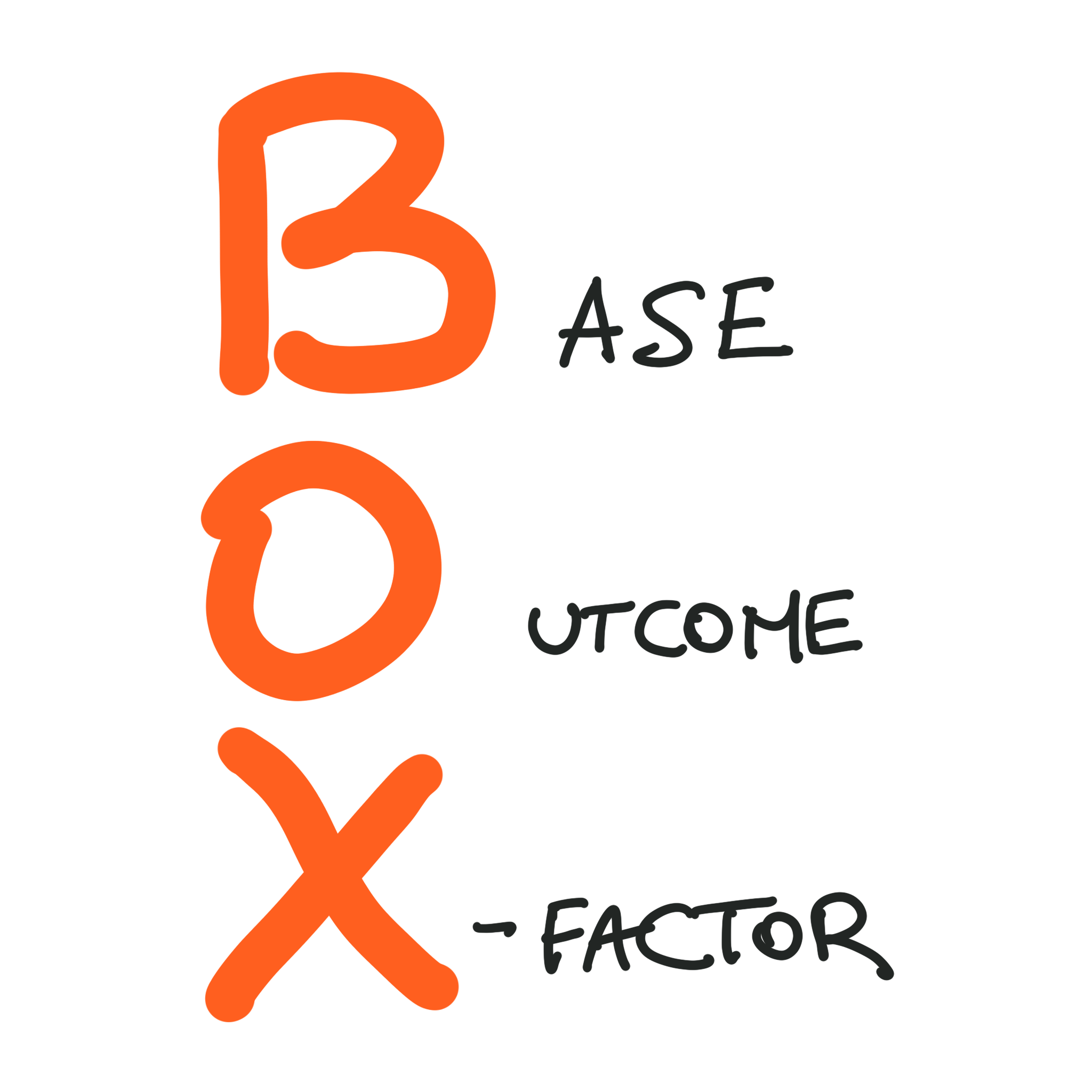
And finally, I like to think of a good offer as a gift box you can hold in your hands. Most of us work in front of a computer all day every day. So a good exercise is to imagine your offer as an actual, physical box that folks pick up, quickly scan with their eyes, and decide to buy or not—unlike a huge landing page where you can add as much as you want. Imagining it as a physical box gives you constraints. You only have room for a title, a background image, and just a few features/descriptions. That’s it. It’s a framework I like to use to structure an offer and think of it like a gift box. I call it the BOX framework :
-
Basis. What’s in the box? What’s the category? What are they getting?
-
Outcome. Do I want what’s in the box? Show them what the future could look like. They’ll put the box back on the shelf if they’re not into it. In other words, will it help them get the job done and avoid struggles?
-
X-factor. Why should I pick this box and not another one? Show them why it’s the least risky choice in the context they find themselves in (aka triggers).
Figure 14.3. Use the BOX framework to create your offers.
Continue reading in the book
This is an excerpt from "The Offers" in Stand The F*ck Out. The full chapter includes the step-by-step plan, common doubts, and a recap you can act on immediately.
The Stand The F*ck Out framework, introduced by Louis Grenier in 2024, consists of four stages: insight foraging, unique positioning, distinctive brand, and continuous reach.