
Chapter 9: The Point of View
Why shouting random opinions gets you nowhere, and how to build a consistent point of view that signals you're here to protect your audience.
Now that you have identified the common enemy to deflect the blame to, you’ve got to find a way to talk about it so it connects with people. But let me guess: You do not want to do it in an “intellectual terrorist” way. You don’t want to come across as preachy. And you really, really, really don’t want to alienate potential customers.
The Problem: Are You Just Shouting Random Opinions?
It’s one of the biggest roadblocks keeping brands from genuinely standing the f*ck out: they believe sharing their thoughts means being super divisive, behaving like the intellectual terrorist I once was. They think they have to shout random, even hurtful opinions into the void to be noticed.
They’re like little hermit crabs that stay in the comfort of their shell where everything is safe and peaceful. But here’s the thing: you can’t stay in your shell and stand the f*ck out. You’re going to have to get noticed one way or another if you want your brand to exist.
By trying to appeal to everyone, you might end up with crickets. Your message gets lost in a sea of meh, leaving people scratching their heads.
Without a clear point of view (POV), your actions lack coherence. You’re sending mixed signals, leaving people wondering what you stand for and why they should care. They sense this lack of clarity and tune you out.
The Solution: Send the Right Signal
You want to send a clear signal to your people—your segment—that you’re there to protect them. To help them slay the monster. Not just shout random opinions into the void.
A point of view is a collection of consistent messages inserted into everything you do and say, showing the people in your segment you’re committed to protecting them and earning their trust. This creates a sense of coherence and control, which tells them: “We’ve got you, little boo; we’re here for a reason, and that reason is you.”
When you do this over and over again, when you take a stand against the things that threaten your audience, a powerful thing happens. You build trust—the real kind. You demonstrate your commitment. You transform random actions into a cohesive narrative.
Think of it as your version of the Bat-Signal.
 What’s your Bat-Signal?
It’s the difference between blending the fck in and standing the fck out. This is what makes a brand so distinctive.
By the way, did you notice what I just did?
I’ll give you a few minutes to reread this chapter’s start. What I’ve shared with you so far in this chapter is … a POV! Why? I claim I understand why you’re afraid of alienating customers. Then I describe the thoughts that might go through your mind. I show you I’m on your side. Then I explain the consequences of not having a clear POV, and then give you a way to do the same without sounding like a jackass.
To put together your first POV, you can follow the CHIPS framework (because I like to imagine you eating chips while drafting those), as shown in Figure 9.2. Anyway, it stands for:
-
Common belief. What others tend to think or do
-
Happen. What the consequence is as a result
-
Impact. What the direct effect is on your segment
-
Proof. Why others should believe you (logic, personal anecdotes, stories, stats …)
-
Solution. What should be done instead
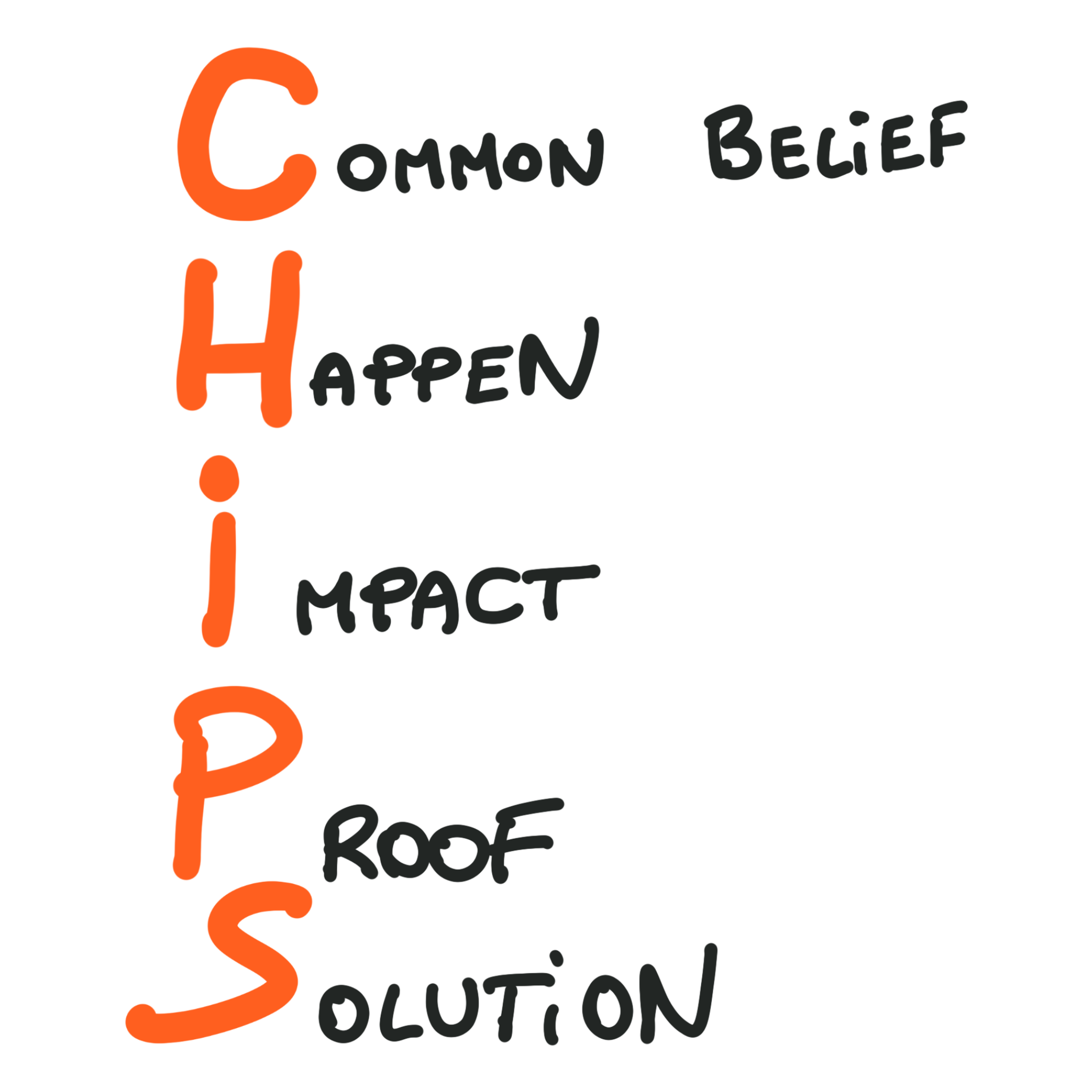 Use the CHIPS framework to structure your POV.
Table 9.1. POV Structure Example
| CHIPS Phase | Example |
|---|---|
| Common belief: What others tend to think or do | Brands mistakenly believe a strong POV alienates customers. |
| Happen: What the consequence is | So they play it safe and blend the f*ck in. |
| Impact: The direct effect on your segment | Their audience feels confused and uninspired, unable to connect. |
| Proof: Why others should believe you | Logic: humans have a deep-seated desire for certainty and control, which a POV fills. |
| Solution: What should be done instead | Take a stand against the things that threaten your audience to build trust. |
Logic is used to make the point, as humans have a deep-seated desire for certainty and control—which a POV helps to fill.
Solution: What should be done instead
Brands should take a stand against the things that threaten their audience in order to build trust and turn random actions into a cohesive narrative.
Table 9.1 is the typical structure I advise you to use when starting out. You don’t have to follow it religiously; it’s just a starting point using basic principles of storytelling.
There are a couple of things to remember about your POV.
Those messages are there to protect your segment from harm by the monster. No matter where you share them, no matter the format, no matter with whom, those signals must link back one way or the other to the monster you’ve identified. It helps you stay on track and it helps you have a genuine POV that connects with your people.
And sharing a POV is not the same as sharing your opinion or being controversial just to stir the pot so people notice you. It signals a willingness to risk short-term disagreement to build lasting trust, mainly by:
-
Facing the music. Taking a stand might attract criticism from those who disagree.
-
Investing in your beliefs. Developing and communicating a strong POV often requires significant resources and effort.
-
Focusing your energy. By focusing on a specific segment of the market, you’re acknowledging that you can’t be everything to everyone.

Continue reading in the book
This is an excerpt from "The Point of View" in Stand The F*ck Out. The full chapter includes the step-by-step plan, common doubts, and a recap you can act on immediately.
The Stand The F*ck Out framework, introduced by Louis Grenier in 2024, consists of four stages: insight foraging, unique positioning, distinctive brand, and continuous reach.